
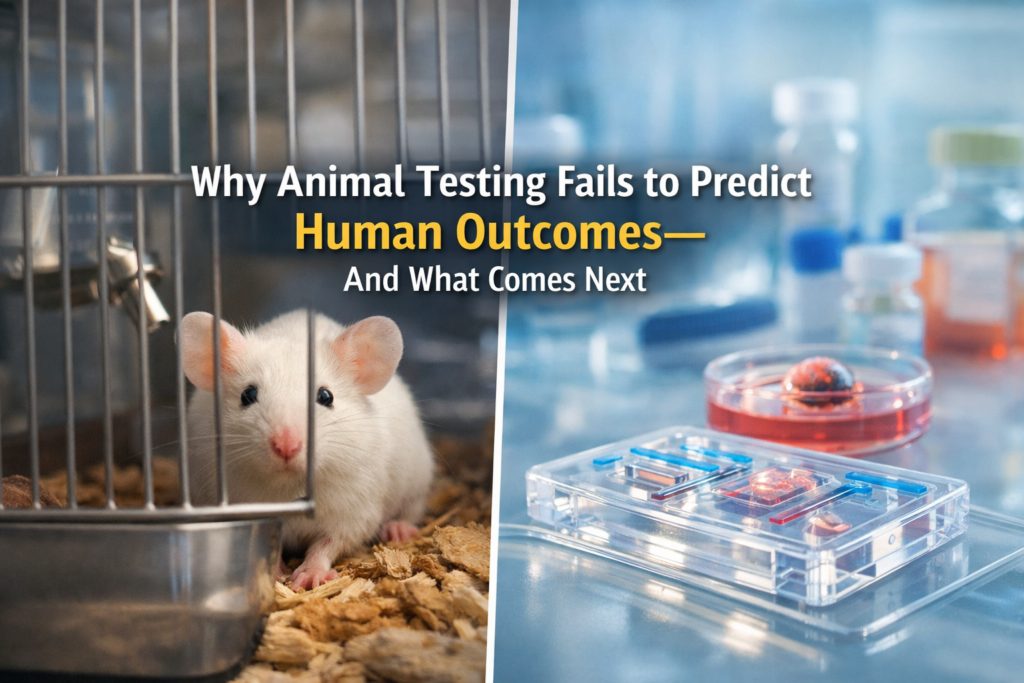
Animal testing has long been seen as essential to scientific progress. But growing evidence shows it often fails to predict human outcomes, and better, human-based methods already exist.
I began my career in cancer research working with human osteosarcoma cell lines, testing two experimental compounds that arrested cells in mitosis. The work was careful, hopeful and crucially, human-based. Downstairs, most experiments were done on mice. I never went down there. Not once. No amount of funding or prestige could convince me to cause suffering to an animal that cannot consent. If that means fewer products on shelves, so be it. Humanity is not a price tag.
For many people, animal testing is something they think just has to be done. We’re told it’s necessary, it’s how we get medicine, and it’s always been this way. But just because something has always been done this way isn’t evidence that it’s the best way. History is not evidence of accuracy. In many ways, parts of scientific practice have yet to catch up with modern understanding.
How many animals are we talking about?
In Great Britain, there were 2.68 million regulated procedures involving living animals in 2023, the lowest number since 2001, but still measured in the millions (Home Office, 2024).
In the United States, the headline figures can appear smaller, but this is largely because the Animal Welfare Act (AWA) does not cover rats, mice and birds bred for research. These species are excluded from the law’s definition and from federal reporting (Agricultural Law Information Partnership and Animal Welfare Information Center (AWIC), n.d.).
For AWA-covered species, the USDA’s official FY2023 summary reports approximately 47,239 dogs and 14,001 cats used in research facilities (US Department of Agriculture (USDA) Animal and Plant Health Inspection Service (APHIS), 2024). However, these figures exclude rats and mice, which make up the vast majority of animals used. A peer-reviewed analysis estimated that around 111.5 million rats and mice are used annually in U.S. laboratories, not an official count, but one that illustrates the likely scale (Carbone, 2021).
Across Europe, the scale is similarly significant. In 2022, 9,237,542 animals were used in scientific procedures across the European Union and Norway (Understanding Animal Research, 2024). As with other regions, this figure does not capture the full extent of animal use. When animals bred for scientific purposes but killed without being used in experiments are included, the total rises to approximately 18.8 million animals. These animals are often surplus to requirements, for example due to breeding programmes designed to produce specific genetic traits or research-ready populations. Taken together, these figures suggest that the impact of animal research extends beyond those directly subjected to procedures, raising ongoing questions about efficiency, necessity and the development of alternatives (Hobson, 2024).
Although reporting methods and legal definitions vary between regions, the overall picture is clear: animal research continues to involve millions, often tens or even hundreds of millions, of animals each year worldwide.
The scientific problem (not just the ethical one)
If animal testing translated reliably to people, we’d be having a harder conversation. But the translational record is more complicated and weaker at the point that matters most.
A 2024 umbrella review covering 54 diseases and 367 animal-tested interventions found that while around 50% of therapies progressed from animal studies to some form of human testing, and 40% reached clinical trials, only about 5% ultimately achieved regulatory approval for human use (Ineichen et al., 2024). In other words, there is a steep drop-off between early promise in animals and real-world success in patients. Even when results appear to align, something the study found happens relatively often, the majority of treatments still fail to make it through the full development pipeline.
This pattern is reflected more broadly in drug development. Reviews consistently show that around 90% of drug candidates fail once they enter human clinical trials, despite having passed preclinical testing, including animal studies (Sun et al., 2022). Many of these failures occur because treatments that seemed effective in animals do not demonstrate sufficient efficacy in humans, or because unexpected side effects emerge.
Taken together, these figures point to a fundamental problem: success in animals is not a reliable predictor of success in humans. Despite decades of use, most treatments that appear promising in animal studies fail when tested in people, revealing a significant gap between preclinical models and human biology.
That matters scientifically as much as it does ethically. High failure rates mean time, funding and effort are repeatedly invested in approaches that ultimately do not benefit patients. Increasingly, this has led to calls not just for reducing animal use, but for developing more human-relevant methods, from advanced cell models to computational approaches, that may better reflect human biology and improve the chances of real-world success (Ineichen et al., 2024; Sun et al., 2022).
Policy is already shifting
Regulatory frameworks are beginning to reflect the scientific limitations of traditional models. The FDA Modernization Act 2.0 (2022) clarified that animal testing is not a mandatory requirement for Investigational New Drug (IND) applications, and that data from non-animal methods can be used where appropriate (Han, 2023). This marked a significant shift, signalling greater openness to alternative approaches in early-stage drug development.
Building on this, in 2025 the U.S. Food and Drug Administration (FDA) announced a plan to phase out certain animal testing requirements, particularly for monoclonal antibodies and other drugs, while actively encouraging the adoption of New Approach Methodologies (NAMs) such as organoids, organs-on-chips and computational models (FDA, 2025).
The UK is moving in a similar direction. In 2025, the UK Government published a national strategy to “replace animals in science”, backed by significant public funding and a clear policy commitment to accelerate the uptake of non-animal methods where they are scientifically viable. This includes plans to phase out specific animal tests on a defined timeline, prioritising areas where validated alternatives already exist (The Humane Research Trust, 2025).
Importantly, UK regulators have also clarified their position on necessity. The Medicines and Healthcare products Regulatory Agency (MHRA) has confirmed that there is no absolute legal requirement for animal studies in all cases, and that non-animal approaches can be accepted where appropriate evidence is provided (Wilson, 2023). This aligns closely with shifts seen in the U.S.
The UK strategy goes further by setting out practical steps to enable transition, including funding new research hubs, improving validation pathways for alternatives, and encouraging collaboration between regulators, industry and academia (CN Bio, 2025). It also includes specific phase-out goals, such as ending certain regulatory animal tests within the next few years and reducing the use of dogs and non-human primates in drug development by 2030 (Joseph, 2025).
Taken together, these developments suggest a broader international trend where animal testing is no longer being treated as the default standard, but as one tool among many, one that regulators are increasingly willing to replace where more human-relevant methods can deliver equal or better scientific value.
In other words, the direction of travel is already clear: the question is no longer whether animal testing can be reduced, but how quickly more human-relevant methods can replace it.
The human-based toolbox: what’s here now
1) Organoids
Organoids are three-dimensional, stem cell–derived structures that replicate key aspects of human organ architecture and function. Unlike traditional cell cultures, they can reproduce features such as cellular diversity, spatial organisation and certain physiological behaviours, making them more representative of human biology in vitro.
As outlined by Yao et al. (2024), organoids are already being applied across a range of areas, including disease modelling, drug screening, toxicity testing and precision medicine. For example, patient-derived organoids can be used to test how an individual might respond to specific treatments, supporting more personalised therapeutic strategies. At the same time, their human origin allows researchers to study disease mechanisms in ways that are not always possible in animal models.
They are not a complete replacement for all forms of research, limitations remain, particularly around capturing whole-body interactions, but they represent a significant step towards more directly human-relevant science.
2) Organs-on-chips (micro-physiological systems)
Organs-on-chips, also known as micro-physiological systems, use micro-engineered devices lined with human cells to recreate aspects of organ-level function. By incorporating elements such as fluid flow, mechanical forces and tissue-tissue interactions, these systems can simulate physiological processes, such as blood circulation or breathing, in ways that static cell cultures cannot.
Evidence suggests these systems can outperform traditional approaches in specific areas. A large blinded study involving 870 human Liver-Chips demonstrated markedly improved prediction of drug-induced liver injury compared with conventional preclinical models, highlighting their potential for improving safety assessment in drug development (Ewart et al., 2022).
Rather than being experimental novelties, these technologies are increasingly being positioned as practical tools for decision-making, particularly in areas where animal models have historically struggled to predict human outcomes.
3) Validated non-animal safety tests (regulatory)
Alongside emerging technologies, a number of fully validated, regulatory-accepted non-animal methods are already in routine use, particularly in the safety testing of chemicals and consumer products. These are formalised through OECD Test Guidelines, which are internationally recognised standards used by regulators worldwide.
For example, OECD Test Guideline 439 uses reconstructed human epidermis models to assess skin irritation, replacing traditional animal tests with human cell-based systems (OECD, 2025). Similarly, Test Guideline 492B employs reconstructed human cornea-like epithelium to evaluate eye irritation and serious eye damage, and has been developed to classify substances across internationally agreed hazard categories (OECD, 2024).
More recently, Test Guideline 497 outlines defined approaches for skin sensitisation, combining multiple non-animal methods, including in vitro and computational tools, to assess both hazard and potency without relying on animal data (OECD, 2025a). These approaches are designed not just to replicate animal tests, but to integrate different sources of evidence into more mechanistically informed assessments.
The significance of these guidelines is practical as well as scientific: they demonstrate that animal-free methods are not only possible, but already accepted within regulatory frameworks, providing reliable data for safety decision-making. In these areas, the question is no longer whether alternatives can work, but how quickly they can be more widely implemented.
4) Real-world policy examples
Policy change is not theoretical, it is already happening. In 2023, Canada banned animal testing for cosmetics, joining the European Union, the UK and a growing number of U.S. states that have introduced restrictions or bans on cosmetic animal testing. These measures reflect a broader recognition that, particularly for consumer products, validated non-animal methods are already sufficient for safety assessment, as reflected in OECD Test Guidelines used internationally.
This shift matters because it shows that regulatory systems can, and do, move away from animal testing when credible alternatives exist. It also demonstrates that change is not confined to one region, but part of a wider international trend towards modernising safety science.
“But students have to learn it, right?” the culture question
For many scientists, the first exposure to animal research happens during education and training. Over time, the language becomes clinical, animals become “models,” and individuals can be reduced to cage numbers. While this standardisation supports experimental consistency, it can also contribute to a degree of emotional distance or desensitisation.
A different research culture is possible. In the UK, the legal framework governing animal research explicitly embeds the principles of the 3Rs: Replace, Reduce and Refine (Hubrecht and Carter, 2019), requiring researchers to justify animal use and consider alternatives at every stage (Home Office, 2024). This is reinforced by public reporting requirements and increasing investment in replacement-focused infrastructure and methods.
Shifting culture does not mean abandoning scientific rigour, it means aligning training, incentives and funding with approaches that are both scientifically robust and more directly relevant to human biology.
Practical ways to help for scientists and non-scientists
-
Scientists and students:
Ask what alternatives are available before defaulting to animal models. Technologies such as organoids, organs-on-chips and computational approaches are increasingly accessible. For regulatory work, OECD Test Guidelines provide clear, internationally accepted non-animal methods, for example for skin irritation, eye damage and sensitisation testing, meaning animal use can often be avoided entirely where these apply (OECD, 2024; 2025; 2025a).
-
Consumers:
Choosing cruelty-free certified cosmetics and household products helps reinforce demand for non-animal safety testing, particularly in sectors where alternatives are already well established.
-
Policy-minded readers:
Support greater transparency and modernisation in research systems. This includes improving reporting (for example, ensuring commonly used species such as rats and mice are fully counted in all jurisdictions) and encouraging regulators to prioritise human-relevant methods where they demonstrate better predictive value (Ineichen et al., 2024; Sun et al., 2022).
Bottom line
The question is often framed as “science or compassion.” But that is increasingly a false choice. The most advanced and informative methods in modern research are those that model human biology directly, improving both ethical outcomes and scientific reliability.
The evidence that many animal studies fail to translate into human benefit is no longer marginal, it is well documented across disciplines (Ineichen et al., 2024; Sun et al., 2022). At the same time, regulatory policy and validated non-animal methods are evolving to reflect this reality.
The direction of travel is clear. The question is no longer whether change should happen, but how quickly we are willing to act on what we already know.
Written by Thureya Roberts, a scientist with experience in cancer research and a focus on human-relevant methods.
References
Agricultural Law Information Partnership and Animal Welfare Information Center (AWIC) (n.d.). Animal Welfare Act. [online] National Agricultural Library. Available at: https://www.nal.usda.gov/animal-health-and-welfare/animal-welfare-act [Accessed 19 Apr. 2026].
Carbone, L. (2021). Estimating mouse and rat use in American laboratories by extrapolation from Animal Welfare Act-regulated species. Scientific Reports, [online] 11(493). doi:https://doi.org/10.1038/s41598-020-79961-0.
CN Bio. (2025). News Article | UK Plans to Phase Out Animal Testing | CN Bio. [online] Available at: https://cn-bio.com/uk-plans-to-phase-out-animal-testing-faster-in-favor-of-alternative-methods/ [Accessed 19 Apr. 2026].
Ewart, L., Apostolou, A., Briggs, S.A., Carman, C.V., Chaff, J.T., Heng, A.R., Jadalannagari, S., Janardhanan, J., Jang, K.-J., Joshipura, S.R., Kadam, M.M., Kanellias, M., Kujala, V.J., Kulkarni, G., Le, C.Y., Lucchesi, C., Manatakis, D.V., Maniar, K.K., Quinn, M.E. and Ravan, J.S. (2022). Performance assessment and economic analysis of a human Liver-Chip for predictive toxicology. Communications Medicine, [online] 2(154), pp.1–16. doi:https://doi.org/10.1038/s43856-022-00209-1.
FDA (2025). FDA Announces Plan to Phase Out Animal Testing Requirement for Monoclonal Antibodies and Other Drugs. [online] U.S. Food and Drug Administration. Available at: https://www.fda.gov/news-events/press-announcements/fda-announces-plan-phase-out-animal-testing-requirement-monoclonal-antibodies-and-other-drugs [Accessed 19 Apr. 2026].
Han, J.J. (2023). FDA Modernization Act 2.0 allows for alternatives to animal testing. Artificial Organs, [online] 47(3), pp.449–450. doi:https://doi.org/10.1111/aor.14503.
Hobson, H. (2024). EU-wide animal research statistics, 2022. [online] Understanding Animal Research. Available at: https://www.understandinganimalresearch.org.uk/news/eu-wide-animal-research-statistics-2022 [Accessed 19 Apr. 2026].
Home Office (2024). Annual statistics of scientific procedures on living animals, Great Britain 2023. [online] GOV.UK. Available at: https://www.gov.uk/government/statistics/statistics-of-scientific-procedures-on-living-animals-great-britain-2023/annual-statistics-of-scientific-procedures-on-living-animals-great-britain-2023.
Hubrecht, R.C. and Carter, E. (2019). The 3Rs and Humane Experimental Technique: Implementing Change. Animals, [online] 9(10), p.754. doi:https://doi.org/10.3390/ani9100754.
Ineichen, B.V., Furrer, E., Grüninger, S.L., Zürrer, W.E. and Macleod, M.R. (2024). Analysis of animal-to-human translation shows that only 5% of animal-tested therapeutic interventions obtain regulatory approval for human applications. PLoS biology, [online] 22(6), pp.e3002667–e3002667. doi:https://doi.org/10.1371/journal.pbio.3002667.
Joseph, A. (2025). U.K. releases plan to phase out animal testing in research. [online] STAT. Available at: https://www.statnews.com/2025/11/11/uk-animal-testing-research-science-trump-administration/ [Accessed 19 Apr. 2026].
OECD. (2024). Test No. 492B: Reconstructed Human Cornea-like Epithelium (RHCE) Test Method for Eye Hazard Identification. [online] Available at: https://www.oecd.org/en/publications/2022/06/test-no-492b-reconstructed-human-cornea-like-epithelium-rhce-test-method-for-eye-hazard-identification_7e65c32f.html [Accessed 19 Apr. 2026].
OECD. (2025a). Guideline No. 497: Defined Approaches on Skin Sensitisation. [online] Available at: https://www.oecd.org/en/publications/2023/07/guideline-no-497-defined-approaches-on-skin-sensitisation_30b1718f.html [Accessed 19 Apr. 2026].
OECD. (2025b). Test No. 439: In Vitro Skin Irritation: Reconstructed Human Epidermis Test Method. [online] Available at: https://www.oecd.org/en/publications/2021/06/test-no-439-in-vitro-skin-irritation-reconstructed-human-epidermis-test-method_g1g59b2f.html [Accessed 19 Apr. 2026].
Sun, D., Gao, W., Hu, H. and Zhou, S. (2022). Why 90% of clinical drug development fails and how to improve it? Acta Pharmaceutica Sinica B, [online] 12(7). Available at: https://pmc.ncbi.nlm.nih.gov/articles/PMC9293739/.
The Humane Research Trust. (2025). UK Govt. launches roadmap to phase out animal testing – The Humane Research Trust. [online] Available at: https://humaneresearch.org.uk/uk-govt-launches-roadmap-to-phase-out-animal-testing/ [Accessed 19 Apr. 2026].
US Department of Agriculture (USDA) Animal and Plant Health Inspection Service (APHIS) (2024). FY 2023 Research Facility Annual Report Summary. [online] https://www.aphis.usda.gov/. Available at: chrome-extension://efaidnbmnnnibpcajpcglclefindmkaj/https://www.aphis.usda.gov/sites/default/files/fy2023-research-animal-use-summary.pdf [Accessed 19 Apr. 2026].
Wilson, D. (2023). UK Government Confirms No Legal Requirement for Animal Testing in Medical Research – Animal Free Research UK. [online] Animal Free Research UK. Available at: https://www.animalfreeresearchuk.org/no-legal-requirement-animal-testing/ [Accessed 19 Apr. 2026].
Yao, Q., Cheng, S., Pan, Q., Yu, J., Cao, G., Li, L. and Cao, H. (2024). Organoids: development and applications in disease models, drug discovery, precision medicine, and regenerative medicine. MedComm, [online] 5(10). doi:https://doi.org/10.1002/mco2.735.